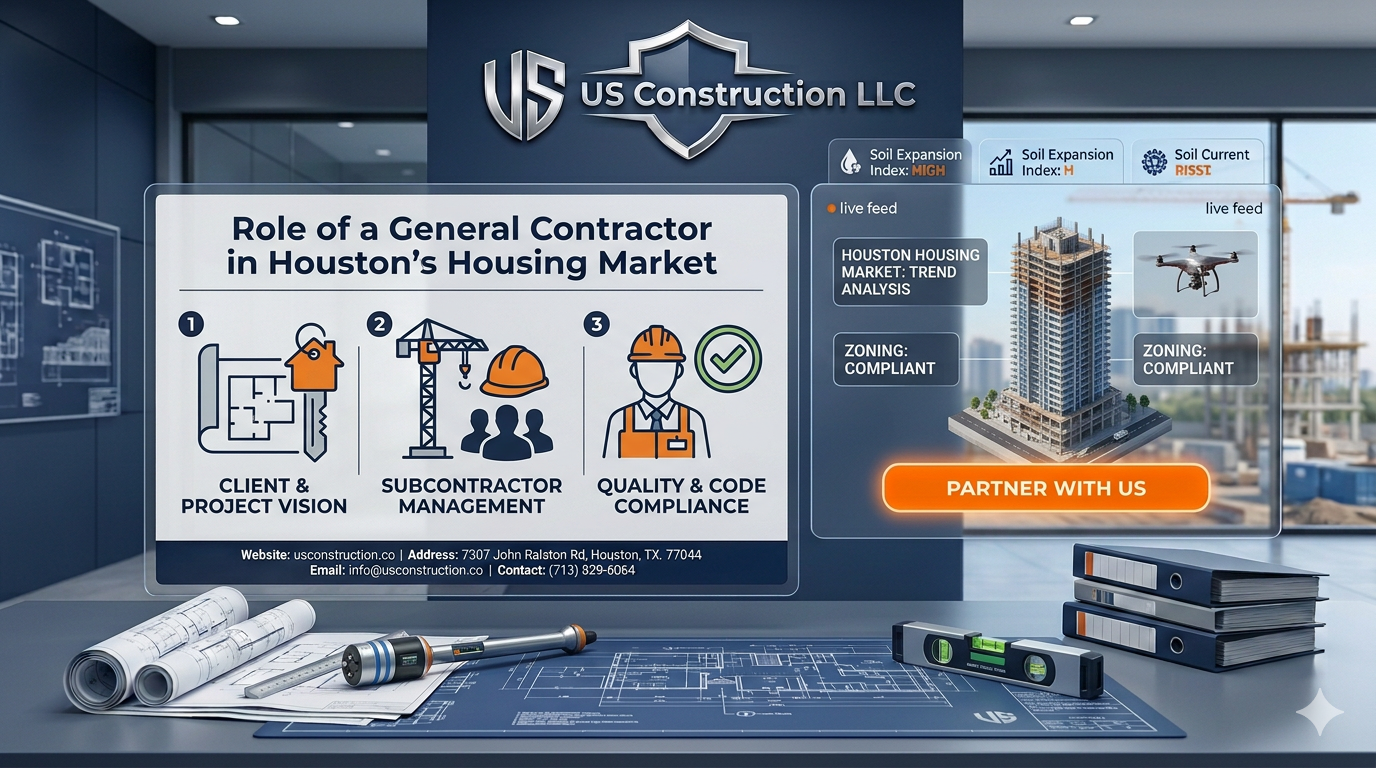
In the United States, Houston ranks second in the number of booming residential developments. The role of a general contractor in Houston’s housing market is central to streamlining timelines and budgets. They manage advanced lifestyle demands, building code compliance, climate resilience, and cost control.
US Construction LLC is an experienced general contracting company with strong connections with municipalities and subcontractors. We effectively plan residential projects to meet permitting requirements and quality control. Houston’s rapid population growth and urban sprawl fuel the new housing construction in suburban areas at affordable prices.
What Is the Role of a General Contractor in Residential Construction?
From preparatory work to final delivery, the Houston general contractor is the primary organization responsible for organizing, directing, and carrying out a residential building project. The GC oversees scope, timetable, funds, quality supervision, employees, regulatory compliance, and risk reduction in their capacity as the primary point of accountability. They play a strategic as well as an operational role.
A detailed breakdown of roles for each project phase is shown below.
Pre-Construction Planning and Feasibility
Before breaking ground, the general contractor. Examines mechanical and architectural drawings. Constructability analysis is performed.
- Creates first cost estimates and budgets.
- Recognizes materials with a lengthy lead
- Evaluates the site’s utilities, soil, and accessibility.
- Works in tandem with design consultants and engineers
Early participation minimizes scheduling difficulties, cost overruns, and modification orders.
Budget Development and Cost Control
The general contractor gets ready comprehensive cost breakdowns (overhead, labor, materials, and equipment). They also add options for value engineering, subcontractor bid packages, and purchase schedules. While development is underway, they keep an eye on:
- Projected versus actual expenses
- Modify orders
- Allocation of contingencies
- Forecasting of cash flow
In residential construction, where margins might be narrow, financial discipline is essential.
Permitting and Regulatory Compliance
Residential projects need to adhere to:
- Local building regulations
- Ordinances about zoning
- Standards for energy efficiency
- Rules governing the environment
- HOA regulations (if any)
The general contractor in Houston, Texas, files permit applications, oversees inspections, ensures code compliance, and responds to rectification notices. If something goes wrong at this point, construction may stop.
Subcontractor Procurement and Management
Most home projects involve multiple trades. It includes site maintenance and utilities supplier. Professionals for foundations and concrete work. Moreover, experienced carpenters, electricians, plumbers, and fine finishes workers. The general construction company manages the following tasks:
- Subcontractors are prequalified.
- Contract negotiations
- Sequencing coordinates trade
- Keeps track of performance
- Upholds safety regulations
Trade coordination avoids costly delays and rework.
Project Scheduling and Timeline Management
Residential construction adheres to a rigid order:
- Preparation of the site
- Establishment
- Framing
- MEP rough-ins
- Insulation
- Drywall
- Finishes inside and outside
- Last-minute examinations
The master schedule is created and overseen by the GC, who also accounts for worker availability, procurement delays, and the environment.
Quality Control and Workmanship Oversight
Among the components of quality assurance are confirming the material specs and examining the framing’s alignment. They are making sure that moisture barriers are appropriate in the structure and examining mechanical installations. The Houston general construction firm makes sure that work complies with plans, performance standards, and structural integrity criteria.
Risk Management and Problem Resolution
Risk factors for construction include weather disruptions, material shortages, design inconsistencies, and soil-related issues. Moreover, they monitor the subcontractor performance. To prevent cascading delays, the general contractor promptly resolves field conflicts, employs mitigation methods, and detects hazards early.
Benefits of Hiring a General Contractor for Residential Construction
Hiring a general contractor for a home improvement project is a risk-management and performance strategy, not just a convenience. From pre-construction to project closeout, a certified general contractor (GC) centralizes accountability, upholds technical standards, and safeguards the homeowner’s investment.
Single Point of Accountability
The homeowner works with a single contractually accountable company rather than managing several trades independently. The local builders manage:
- Oversees all subcontractors
- Oversees agreements and payments
- Handles trade disputes
- Liability for performance is assumed.
Legal liabilities and paperwork demands are greatly decreased as a result.
Accurate Budgeting
Skilled contractors offer comprehensive cost analyses and market-based price insights. They add options for value engineering and order-control changes. They help avoid scope creep, unplanned overruns, and hidden expenses problems that frequently arise in owner-managed builds.
Professional Project Scheduling
Strict sequencing is necessary for residential construction (foundation → frame → MEP → finishing). A construction company creates a master schedule. They specify the trade time, oversee inspections, and proactively adjust for delays. This lowers downtime between trades and increases timeline predictability.
Access to Skilled Network
Reputable general contractors maintain screened trade alliances, including licensed electricians, plumbers, HVAC experts, and carpenters. This guarantees skilled labor and affordable subcontractor rates.
Code Compliance Expertise
Zoning laws, building codes, and inspection procedures can all be complicated. A builder obtains licenses, oversees inspections, and guarantees adherence to regional laws. They are responsible for issuing rectification notices. This reduces the possibility of fines, rework, or stop-work orders.
Risk Mitigation and Problem Resolution
Unpredictability in construction projects includes weather disruptions, material shortages, soil issues, and design inconsistencies. A Houston general contractor identifies hazards, implements mitigation strategies, and addresses problems before they worsen.
Safety Management
A qualified contractor adheres to the following safety procedures on the construction site: OSHA requirements, equipment safety requirements, and hazard mitigation. For homeowners, this reduces liability risk.
Insurance and Warranty Protection
Generally, licensed general contractors carry general liability insurance and workers’ compensation coverage. Bonding (if necessary). In addition, they offer artistry warranties that safeguard the homeowner once the project is complete.
Time Savings and Reduced Stress
To independently oversee a home building project, you need to coordinate vendors, purchase materials, organized inspections, and administer contracts.
These operational duties are handled by a contractor, freeing the homeowner to focus on decision-making rather than daily oversight.
Houston Residential Contractor Near Me
In a highly competitive residential construction market in Houston, choosing the correct experienced general contractor can mean the difference. They are responsible for timely project completion within allocated resources. Skilled leadership ensures your residential construction is built to last, from top-notch execution and risk mitigation to permits and cost control.
Contact US Construction LLC at (713) 829-6064 or visit www.usconstruction.co to schedule your consultation and move your project forward.